
 Edelweiss Patterns
 If you have ever wondered, “What is the difference between silk shantung and silk dupioni?”, this article is for you! If the question has never crossed your mind before, I highly recommend taking a few minutes to learn the differences between dupioni and shantung, two of the most magnificent fabrics on the market.
For ages, silk fabrics have been accepted as the creme’ de la creme’ of fashion fabric. Whether it was for Elizabethan gowns, Regency frocks, Civil War ballgowns, Edwardian wedding dresses, 1930s evening wear, or 1950s party gowns, silk in its various forms has been indespensible. In Europe and the Far East silk has long been esteemed as the finest fabric for royalty to wear, and in America our First Ladies rarely appear on camera without it. Today, two of the most popular and elegant silks are silk dupioni and silk shantung. Those luxurious, textured fabrics with the crisp feel and brilliant lustre are often seen in formal gowns, party suits, wedding attire, and the occasional heirloom christening gown.
But there is often a level of confusion as to what exactly differentiates between a dupioni and a shantung, as they have so many similiar characteristics and can be used for most of the same purposes. In fact, even silk fabric vendors will sometimes neglect to properly categorize their fabric labels, leaving customers confused as to which is really which. But since I spent years working in one of America’s largest bridal fabric stores, I got to experience and handle on an every day basis the feel, body, and appearance of these two magnificent materials, which I hope can be a help to those who are curious as to their differences.
Besides the obvious difference of origin (“dupioni” being Italian and “shantung” being Chinese), there is only one clue as to which category a silk falls into:
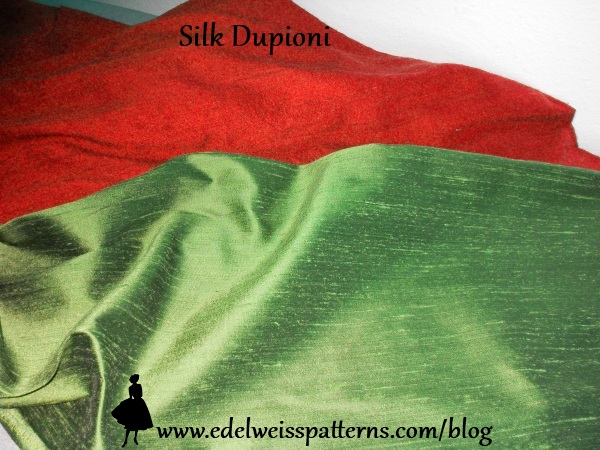
Silk Dupioni has much more prominent slubs (those crosswise irregularities in texture) and is the thicker of the two materials, almost comparing to the feel of a light or medium weight taffeta. Dupioni has an almost rustic look to it in weave only, but the incredible sheen and vibrant colors that silk dupioni is known for can render it suitable for prom dresses, bridal gowns (when paired with an appropriate lace), dazzling women’s suits, and even baby outfits.
So what will dupioni not work for? Of course that is a question which ultimately the seamstress will need to determine, but any pattern that requires a drapey fabric or a very smooth sort of “satiny” material will not work well with silk dupioni. Dupioni is generally cut with the slubs stretching horizontally across the garment, which is exactly how it should automatically turn out if you use your pattern layout instructions as directed. However, I have known several women who were concerned about these lines adding visual width to their outfits, and therefore decided to re-determine the yardage layouts to accomodate the slubs going lengthwise for a more slenderizing look.
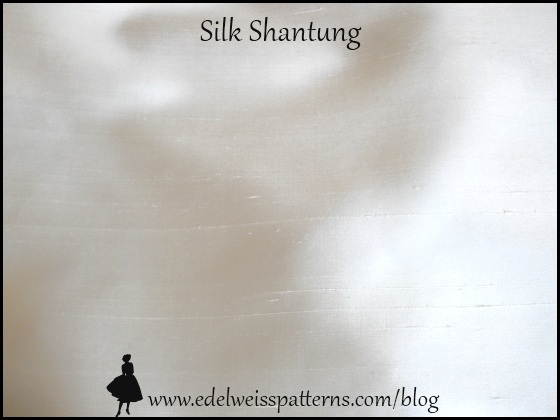
Silk Shantung has hardly any slubs, and those that it does have will be much smaller in thread width than a silk dupioni. In addition, while the silk shantung will still have a fair amount of body and that lovely crispness, it will usually be much thinner than the dupioni and will therefore be suitable to more delicate garments. Silk shantung can almost appear flowing, and is the perfect “happy-medium” between a drapey silk charmeuse and a stiff silk dupioni or taffeta. Besides the popular uses of silk in home decorating and quilting projects, silk shantung is terrific for evening wear, flower girls’ dresses, bridal gowns or sashes, fabric flowers, First Ladies’ gowns, or any special occasion that calls for an exquisite outfit. Historically, this fabric is very similar to a silk used in the Regency era (1795 – 1820) for ball gowns, whereas a true dupioni is completely inaccurate for the time period.
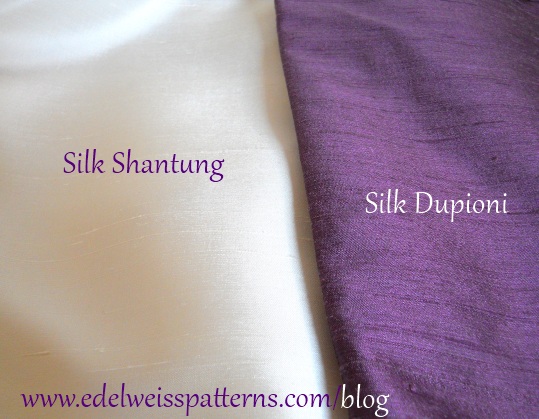
Unless you can go to a fabric store nearby and spend a few minutes feeling the difference between these two fabrics, you may not notice a difference right away. But with some practice you will soon learn to differentiate between the two, and will enjoy the benefit of determining exactly which material will work best for your next project.
Happy sewing!
Katrina


Thanks for this article Katrina! My mom and I just made a ball gown out of silk dupioni, which is some of my favorite fabric. I love that stuff! : )
Blessings,
Allison
Glad you liked it, Allison! That ball gown sounds absolutely stunning – do you have any pictures?
Happy sewing,
Katrina
VERY good article. Really nicely done.
I know which one is which, but sometimes I can’t recall what kind has the slubs and what doesn’t! lol.
So now I will totally recall them. 🙂
The colors of silk are really pretty too I might add.
I am working on a victorian gypsy bodice right now that has real silk for the bodice and this amazing sheer black silk for the sleeves. 🙂 So silk has been on my mind. 😉
Thank you, Brielle! I will have to look for pictures on the Victorian project you referred to.
Happy Thanksgiving and happy sewing!
Katrina
This is great info, Katrina. I’ve posted a link to it up on the main site menu of WeSewRetro.com (under ‘Vintage Sewing Academy’)
Thank you, Katherine! I hope it will be a help to people!
Happy sewing,
Katrina
How are they both to work with as quite a novice clothes sewer? Is it better to stick to cottons? I’ve been eyeing up using silk for a Spenser jacket.
Hello LadyD,
Yes, both silk dupioni and silk shantung are fantastic to work with, though shantung will likely be just a little more slippery. But I would definitely think you could use a silk dupioni for that Spencer jacket with no troubles at all. In fact, after a cotton broadcloth silk dupioni is probaby the easiest fabric to sew with. It has a wonderful amount of body, and takes steam wonderfully.
The only thing I would say is to shrink your silk by steaming it rather than pre-washing it. While silk can be washed, its texture and sheen will be greatly dimished by going through the washing machine.
Hope this helps!
Katrina
Thank you for this very useful article! I have one question what kind of interfacing would you recommend using with dupioni and Shantung?
Thank you so much!
Hi Emma!
That’s an easy answer actually, because I happen to know that lady who invented the interfacing specifically designed for silks! Pati Palmer and Marta Alto (both designers for McCalls) created an excellent line of interfacings available at their website . One bridal seamstress I know took every type of fusible interfacing on the market and fused it to a piece of dupioni, and she found that the Palmer/Pletsch type is the only kind that didn’t show through on the right side of the fabric.
Happy sewing!
Katrina
Thanks for publishing this! Wonderful comparison! Very helpful for especially when one has to order sight unseen!
Mood Fabric labels silk as “Shantung Dupioni” so is that a cross between Italian and Chinese or is it technically mislabeled? Thank you.
Hi, Isabel!
I’ve never used that silk from Mood Fabrics before, but from the swatches they show online it looks more like a dupioni. It might not be quite as rustic as a regular dupioni, but those slubs definitely take it out of the more refined “shantung” category.
Hope this helps!
Katrina
Hi, Katrina!
Have an unusual question about the dupioni silk. We ordered a baptisimal gown out of dupioni silk and after the ceremony the baby had a diaper accident and left some stains on the gown. The godmother immediately rinsed the gown and possibly wrung is out and hung it to dry. I was not there when it happened or I would have stopped her. I believe she was told to rinse in cold water and I’m not sure that was the correct thing to do. I did tell her to take it to a specialty dry cleaner and mention what the stains were. When she picked the gown up they told her they could not remove the stains. Any hope here for another try at removing the stains before I preserve the gown? I’m the grandmother(Dad’s mom).
Hello, Elisabeth,
Oh dear! That’s one problem I’ve never run into with silk. 😉 While I’ve never tried this method myself, the Bridal Sewing Book by Palmer/Pletsch states that a product called Z’out works wonders for different types of stains. I’ve never used it so I can’t endorse it, but maybe the product will work for you!
Hi, That was a really lovey and informative article, just for my info, would it be possible for you to take the 2 different types of silk with the same colour and take a picture, i couldnt figure out between the white and purple/lilac. if its not too much of a bother and at your convenience
Hello there!
Yes, at some point I’ll try to do that, but for the next month or so my schedule is pretty much jam packed with my soon-to-come England costuming trip. If you zoom in on the photos above it might help you – one is significantly more textured than the other.
Happy sewing!
Katrina
Hello
Would Shantang silk be suitable for a knife edge pleated skirt please.
Many Thanks,
Linda from Dublin, Ireland.
Hello, Linda!
Yes, Shantung would totally be suitable for a knife edge pleated skirt! In fact, it would be stunning!
Hope this helps. 😉
Happy sewing,
Katrina
Hi:
Thanks so much for this helpful explanation. I have a question for you. What kind of silk would you recommend for a hand-pleated lampshade? The maker says it needs to be very soft, but not sheer.
Jane
Hi Jane!
Hmmm… Well, home decor sewing is definitely not my forte, but I do know lots of silks so hopefully I can be of assistance. You might try silk shantung, silk charmeuse, or silk noile. All of those fabrics would make a very different finished shade than the others, so you’d definitely want to visit your local fabric store and see what their options are.
Hope this helps!
Katrina
Would you say a silk shantung fabric is more breathable, as it is thinner, than a silk dupioni?
Hi Christine!
Well, actually silk shantung is a tighter weave than silk dupioni most of the time, so they probably would both be just about as breathable. However, shantung does have a more delicate finish than a more rough dupioni, so it would at least be more comfortable to wear than a dupioni.
Hope this helps!
Katrina
Hi Katrina:
I need to make a dress similar to this Claire Pettibone one. would you recommend the shantung or a charmeuse?
http://www.clairepettibone.com/alma
Thanks, Irene
Hello, Irene,
It all depends on what look you are going for. Charmeuse is going to be extremely drapy and fluid, while shantung will have more body and create a better base for the lace to be attached to.
Happy sewing!
Katrina